

A product catalog is a type of marketing collateral that lists essential product details that help buyers make a purchase decision. These details include product features, descriptions, dimensions, price, weight, availability, color, customer reviews, and more.
“A product catalogue is a type of marketing collateral that lists essential product details that help buyers make a purchase decision.”
Who Needs Product Catalogs?
Product catalogs are useful to several business users and groups such as sales reps, inside sales, buyers, store clerks, field marketers, and managers. Here’s how each group uses it:
- Sales reps and inside sales teams use a product catalogue to convey vital information about a product or a service to their customers. They can refer to it while communicating with their prospects and customers about the benefits of using their products.
- Buyers and decision-makers need it as reference material while making a purchase decision. It helps them to compare different products/services from various vendors and decide the most suitable option for their business.
- Store and warehouse managers, shift managers, and operators use it to know about the details of the inventory in their go downs.
- Field marketers can use it while they are walking customers through demos of their products and solutions. It helps them dive deep into their offering and offer value to their customers as the latter group is experiencing the product.
- External parties such as agencies, partners, resellers, and value-added sellers use it to get information about a product and service and sharing it with end-users.
9 reasons why you need product catalogue’s
Before we go any further, let us understand why we need product catalogs.
- To Glean Information
Information such as technical information and features about products is impossible to memorize. Recording them on documents in a usable format helps the user know about a product in detail. Publishing information on product information packs that find a place on websites allows customers to know about it without a sales rep’s interference.
- Reduce Business Cycles
Imagine having to go back and forth with customers on emails sharing information endlessly, which leads to no positive outcome. Instead, sharing information on digital catalogues can help move the deal from one stage to the other. With information available to customers efficiently, it reduces clogs within the business cycle.
- Help Sales Reps Sell
Sales reps have just one primary responsibility – to sell. Collecting product data from different sources inside a business to disseminate to customers is not what they are paid to do. That is why digital catalogues help them share information effortlessly to their customers and generate sales. It saves them valuable time as all the information they need is available on their fingertips.

- Improve Conversion Rate
Product catalogues help businesses improve conversion rates as salespeople, and customers/prospects can have contextual conversations instead of spending time on problem discovery and solution. When customers have all the data that they need, they can seek approvals, make decisions, and buy products more efficiently.
- Enhance Branding
Product information documents are useful places to promote a company’s brand. Using distinct colors, images, caricatures, cartoons, logo, font family, and a call to action can enable your brand to stand apart from the rest. Some businesses record their history and journey to establish a connection with their audience without being physically present. This enables users to easily recall a brand after browsing through its product catalogues.
- Smooth Flow of Information
It helps in a steady flow of information between internal and external stakeholders from the origin to the final destination. Product marketing teams, who are responsible for catalogues, can publish information on content management systems (CMSs) for end-users (sales teams and customer success teams) to use. There is no fretting over stale information in emails, CRMs, storage repositories, desktops, and libraries.
- Generate Sales Offline
Today, buyers research products online and make purchases offline – in malls, shops, events, etc. In such instances, it is important to help customers with information on their mobiles and iPads to fast-forward the buying process. Websites, landing pages, and microsites enable customers to research the requisite information to make up their minds.
- Enhances User Experience
When customers have product information in a PDF or a webpage embedded with images, links, reviews, price information, it enhances their user experience. Especially when all information is consistent across different product categories, it moves them one step closer to a purchase. Product marketers must anticipate buyer needs and create catalogues that match them instead of presenting general information.
- Reduces Training Effort
When information on products and solutions is in a digital form, it reduces the need to train and onboard salespeople, partners, retailers, and other users. It shrinks the learning curve as well because users do not need manual intervention.
Ingredients of a Product Catalogue
What are the ingredients of a product catalogue? What should they have to help different stakeholders meet their objectives? A business cannot have multiple documents for various stakeholders unless there are different use cases.
To save you the trouble, we analyzed documents across industries to come up with a broad list of must-haves. These are not specific to any company/industry, so pick the ones that are most suitable for your company:
Product Details (in alphabetical order)
1. Call to Action – What do you expect the target audience to do after seeing your brochure? Download/email/call you/share it socially? Append this information to let users contact you.
2. Certifications – List the certifications earned by the product such as ISO 9001, ISO 27001, etc.
3. Constituents – Mention its core constituents, e.g., copper, steel, alloy. This element varies based on your industry.
4. Customer credentials – Include credentials from customers who have given a thumbs-up.
5. Description – Briefly describe it so users can quickly scan it for reference.
6. Dimensions – Call out the length, height, breadth, weight, the volume of the product.
7. Discounts – Are there any early-bird/seasonal discounts for your product?
8. Features – Include the top features of the product.
9. Guarantee/Warranty – Specify any guarantee or warranty clauses applicable to the product.
10. Ideal conditions of usage – Indicate the best conditions and criteria for using the product. e.g., temperature, surroundings, etc.
11. Name of the product – What is the product name? If you have a brand name for it, don’t forget to include it.
12. Pictures – Pictures speak more than words! They are the most critical component of a catalogue.
13. Price – Mention the price of the product and the currency/geography applicable.
14. Returns – Under what conditions will the company accept returns of the product?
15. Safety measures – If your product requires safety measures before using, include them to inform and educate users.
16. Size – Name the size of the product.
17. Terms & Conditions – Call out the most typical terms and conditions of using the product.
18. Version – Name the version/release/series of the product. e.g., Windows 2016.
19. Year of the launch – Which year was the product launched?
Product Catalogue Management
Product catalogues are detailed documents that need to be organized and managed to ensure higher utility. Here are the different aspects of product catalogue management:
- Storing/Organizing
A business has diverse needs to publish and store product catalogues – such as teams, geographies, campaigns, marketing themes, business units, industries, types, etc.
Based on the unique needs of a business, content management systems can publish and store product documents for their users to access and use. These digital documents must be searchable – which means CMSs must attach tags and attach descriptions to them.
- Timely Updating
All products change – while some of them are subtle changes, the rest are complete overhauls. For example, a hardware product such as a laptop or mobile phone may undergo several upgrades within a year. In these instances, it is vital to update product information continually.
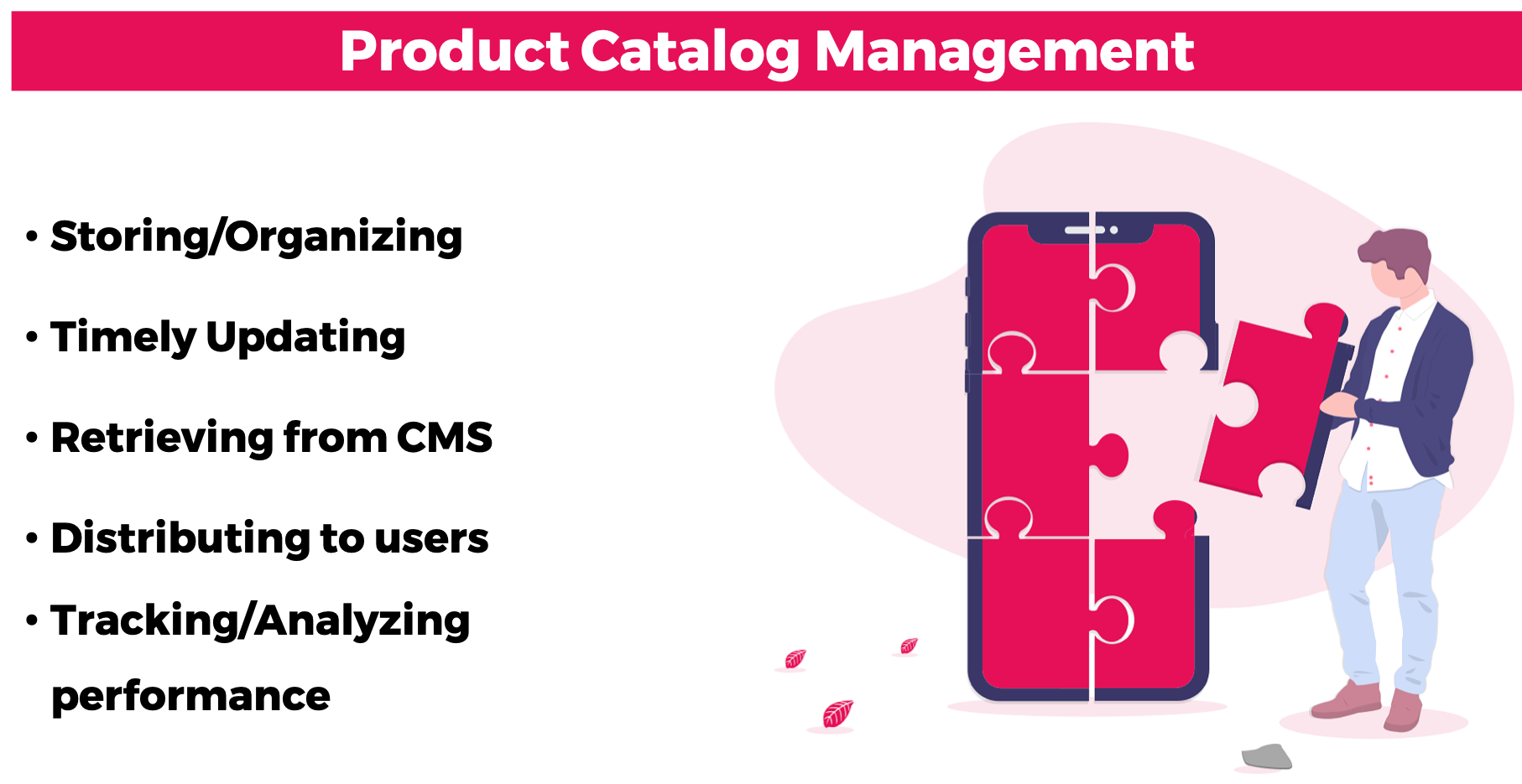
- Retrieving
Product catalogues must be easily retrievable by users who need them the most. For example, an event marketer must be able to pull up his product datasheet on his iPad when he is staffing a booth or to talk to prospective customers on the sidelines. Content management systems help event marketers to deliver the right marketing collateral at the right time to the right prospect.
- Distributing to Users
Product brochures must be distributable to enhance the user experience and help buyers compare products and decide instantly. One way of getting the attention of buyers is by creating personalized microsites with multiple product brochures, each of which conveys vital information. This way, buyers can glide through different brochures, and choose the one/s that suit them.
- Tracking/Analyzing Performance
Users must be able to gain insights from the usage of product information sheets. It includes the number of views, downloads, re-shares, and time spent on each document. CMSs are powered by analytics capabilities that help product managers, marketers, and sales reps to efficiently analyze product performance, boost sales, and deliver a personalized user experience.
For example, in an email campaign, sales reps must know which product catalogue is providing the most value to buyers. It helps sales reps engage with customers meaningfully in sales conversations and fulfill their needs meticulously.
ll their products, design features, composite material, dimensions, instructions, and clinical advantages. It is a universal document that helps dentists, surgeons, patients, partners, and distributors know what is on offer and how they could benefit from it.

Product Catalogues – What You Still Need to Know
Buyers need to make decisions quickly, and businesses need to make their journeys seamless. Product catalogues must feature content that provides them with all requisite information. Hence, marketers must know what makes their product a must-have for buyers and include that information.